The Outcasts’ Return to the Flock
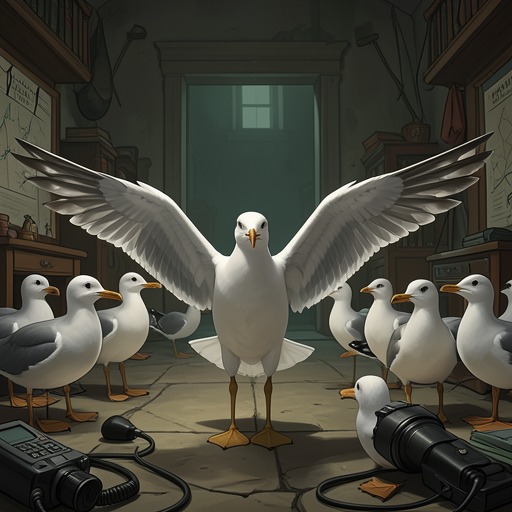
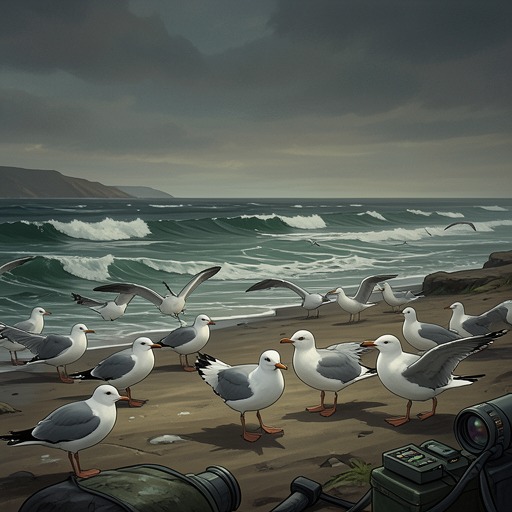
Jonathan Livingston SeagullThe Outcasts’ Return to the Flock is the moment Jonathan Livingston Seagull turns his exile into a challenge to the Flock’s authority. Leading seven fellow outcasts back to Council Beach in a tightly coordinated formation, he violates a ban said never to have been broken in ten thousand years. The Flock answers not with open battle but with an order to ignore them; the returning gulls answer by flying, teaching, and making that enforced silence impossible to sustain.
Background: From Exile to Return
The return grows out of a conflict between two understandings of what flight is for. Most gulls, Jonathan had learned, cared about eating and the practical journey from shore to food; he cared about flight itself. His insistence on flight as a purpose brought him before the Council of the Flock and earned him a formal sentence of shame and banishment to the Far Cliffs. The punishment made him an outcast, but it did not extinguish his conviction that learning and freedom gave life a meaning beyond survival.
His later education enlarged that conviction. In the new world, Jonathan came to understand that heaven was not a place or time but a state of perfection, and that perfect speed was not a record measured by any number. He learned to think of himself as an idea of freedom and flight, no longer limited by bone and feather. Chiang also directed him toward kindness and love. After Chiang’s disappearance, Jonathan increasingly thought about Earth and wondered whether a gull there might be struggling against the same limits he once faced. He decided that teaching such a bird was a way to give what he had learned. His return therefore carries both a practical aim—bringing instruction back to the Flock—and a change in his understanding of flight, from personal pursuit toward a freedom that can be shared.
Breaking the Rule
Jonathan told his students that it was time to return to the Flock. They protested that they were not welcome and could not go where they had been forbidden to go. Jonathan answered through action: they were free to go where they wished and to be what they were, and he lifted from the sand toward the Flock’s home grounds. The students hesitated because the Law of the Flock declared that an outcast never returned. The narrative stresses the rule’s long authority: it had not been broken once in ten thousand years.
The delay threatened to leave Jonathan approaching a hostile community alone. Fletcher Lynd Seagull reframed the decision for the group: as outcasts they were no longer members of the Flock, so they need not obey its law, and they could be more useful at the beach if a fight began. His comment does not erase the danger, but it turns obedience into a choice rather than an inevitability. The students follow Jonathan, making the return a collective act of defiance rather than the solitary gesture of a teacher confronting his former community.
The Formation at Council Beach
That morning eight gulls arrived from the west in a double-diamond formation, with their wingtips almost overlapping. They crossed Council Beach at 135 miles per hour, Jonathan leading, Fletcher at his right wing, and Henry Calvin Gull struggling gamely at his left. Over the beach, the formation rolled together from level flight to inverted and back again. The movement was not merely fast: its synchronized precision made the returning outcasts’ skill visible to the assembled Flock.
The noise of ordinary life stopped as eight thousand gulls watched. One by one, the returning birds pulled sharply upward into full loops and completed dead-slow, stand-up landings on the sand. Jonathan then began critiquing their flight as if the gathering were an ordinary lesson, pointing out that they had been late on the join-up. That calm instructional response sets the display apart from a challenge staged for violence or applause. The outcasts demonstrate their ability, then treat that ability as something to practice and improve together.
The Flock’s Response and the First Change
News that the outcasts had returned spread through the Flock, along with disbelief that the forbidden act could have happened. Some younger gulls acknowledged that the newcomers were outcasts but immediately asked where they had learned to fly like that. Their question exposes a tension inside the spectacle: the Flock’s rule classifies the returning birds as forbidden, while their skill makes them objects of curiosity and possible learning.
It took almost an hour for the Elder’s order to pass through the Flock: ignore the outcasts; anyone who spoke to one or even looked upon one would become an outcast in turn. The prohibition extends the original punishment into a social quarantine, making attention itself an offense. Gray-feathered backs turned away from Jonathan, but he did not appear to notice. Instead, he held practice sessions directly over Council Beach and began pushing his students to the limits of their abilities. Martin William Seagull, challenged to prove his knowledge of low-speed flight, discovered that he could curve his feathers in the lightest breeze and rise from sand to cloud and down again without flapping. The return makes the beach both a site of exclusion and a place where the excluded continue to learn in public.
Teaching, Attraction, and Significance
Jonathan’s presence at the beach was sustained by close instruction rather than a single display. He remained beside each student, demonstrating, suggesting, pressuring, and guiding; he flew with them through night, cloud, and storm while the Flock huddled on the ground. Once practice ended, the students listened more closely to his ideas. Some remained difficult for them to understand, but others made sense through what they could already do. The return thus brings the teacher’s methods into view: physical practice opens a path toward ideas that students have not yet fully accepted.
A second circle gradually formed around the students’ circle. Curious gulls listened in the darkness for hours, unwilling to see or be seen by one another, and disappeared before daybreak. The Elder’s command could regulate acknowledged contact, but it could not prevent private attention. A month after the return, Terrence Lowell Gull crossed the line and asked to learn to fly, knowing that the request itself would make him an outcast and one of Jonathan’s students. The next night Kirk Maynard Gull arrived dragging his left wing and collapsed at Jonathan’s feet, asking for help because he wanted to fly more than anything in the world. These approaches show the return’s consequences spreading beyond its original eight: the demonstration creates a route into learning, even for gulls who must bear the old punishment to take it.
The event’s decisive reversal is therefore not the immediate repeal of the Flock’s law; the evidence shows the order enforced and the gray backs still turned. Instead, the prohibition begins to lose its hold over what gulls can see, wonder about, and choose. Jonathan’s return joins the experience that flight is a source of freedom to a practical invitation to learn. When a voice from the listening multitude asks whether freedom requires setting aside even the Law of the Flock, Jonathan replies that the only true law is the one that leads to freedom. The return gives that claim a concrete form: the outcasts cross the boundary, demonstrate what practice can achieve, and make teaching possible where the Flock’s rule had prescribed silence.